Organizers with the People’s Unity Platform (PUP) have been very intentional about the locations chosen as the backdrop for their rallies and press conferences this summer and fall. In August, they stood in the Gold Coast outside of GCM Grosvenor, the asset management firm of billionaire and political underwriter Michael Sacks.
“We chose this location because we’re right at the base of a person who is draining the lifeblood of Chicago and does not care about the welfare of the people he’s taking advantage of,” Chicago Housing Initiative executive director Don Washington said, referring to Sacks. Known as the so-called “Rahm Emanuel whisperer,” Sacks was a major funder of both Emanuel’s mayoral and Barack Obama’s presidential campaigns.
“In fact, he is actively advancing an agenda that further increases economic inequality,” Washington said in reference to Sacks furthering Trump’s agenda. “For him,” Washington explains about Sacks, “we’re just inputs into a system that feeds and finances, right? We don’t count.”
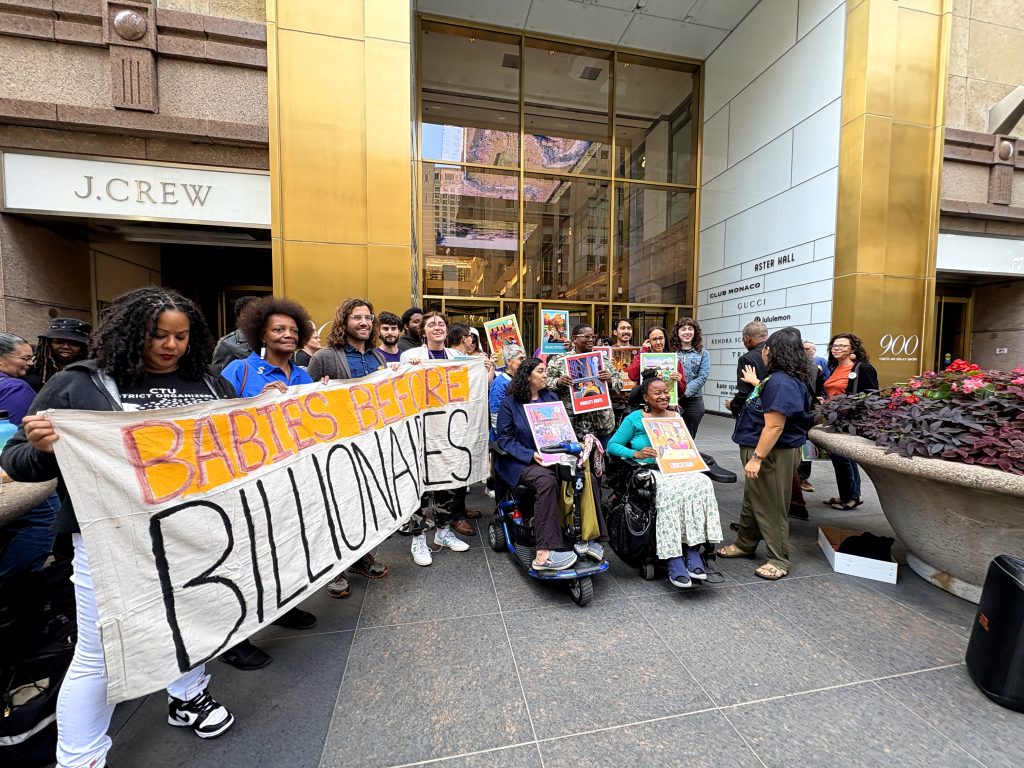
Washington added that Sacks only cares about those in his economic class, “the top 1%.”
Earlier this month, PUP took the fight to the West Loop, which is the home of Google’s Chicago office and the investment firm Valor Equity. Antonio Gracias, the CEO of Valor, was a staff member for the Department of Government Efficiency (DOGE), where he was given the task of reducing spending within the Social Security Administration.
Rocia Garcia, senior organizing director with the Grassroots Collaborative and member of PUP spoke to the crowd at the West Loop action. “Corporate power has gone unchecked for far too long. Right now, corporate CEOs and the politicians in their pockets are creating an authoritarian regime in the U.S. run by and for billionaires,” she said.
“Billionaires are standing in the way of making it possible for working families to have good health care, to put food on the table every week to get their own home, to be able to put our own kids through school,” Garcia said, “and corporations like Google, right behind us, at 320 N. Morgan, are helping him [Trump] along while getting richer.”
Mayor Brandon Johnson warned Black Chicagoans about “the Elon Musks of Chicago” in a March interview with The TRiiBE. Though he didn’t name names back then, Chicago’s grassroots organizers are connecting the dots for residents ahead of the mayor’s fiscal year (FY) 2026 budget address on Oct. 16. Options to raise garbage fees and property taxes, and increase the liquor tax, have been proposed but organizers are demanding taxes on rich corporations and the billionaires that operate them.
PUP is working to implement what they are calling progressive options to close Chicago’s $1.15 billion budget gap. The conversation about progressive budgets is happening across the country in places like New York City, where mayoral hopeful Zohran Mamdani has gained popularity through standing up for progressive causes.
Described as “the people’s budget,” groups like PUP say a progressive budget will benefit the lives of poor and working-class Black and brown Chicagoans at a time when vital services are being cut by the President Donald Trump administration and the everyday Chicagoan is struggling to survive. It calls for diverting away from regressive forms to balance the budget, such as raising taxes on services, and choosing more progressive forms such as taxing major corporations.
Washington spoke on the importance of passing a progressive budget for Black people specifically, stating how Black bodies and labor have historically “been used to create wealth.”
“Every time there’s economic inequality, the people who are closest to the bottom, and that’s Black folks, we suffer more, right?” Washington said to The TRiiBE during the Mag Mile rally in August. “We suffer disproportionate harm from economic inequality.”
PUP recommends four new sources of revenue for Chicago City Council to implement for the FY 2026 city budget.
A Corporate Employer Expense Tax: a flat business payroll expense tax rate that large businesses, which have payrolls over $8 million, pay on their highly compensated employees’ payroll that cannot be passed down to the employee. The tax is expected to create $1.5 billion a year.
Seattle established a Jumpstart Tax in 2021. The tax is on large, high-earning businesses to go toward housing, economic revitalization and climate projects. The tax reportedly raised $255 million in 2022, more than its initial $219 million projection. In 2023, it was projected to raise $223 million and instead brought in $315 million.
Payment In Lieu of Taxes (PILOT): Universities with the largest endowments in the city limits would make a payment to the city and contribute to funding city infrastructure and services, in lieu of paying property taxes, given their tax-exempt status. PUP says PILOTs would generate $250 million a year for the city.
The TRiiBE published a story last year about how PILOTs could help close the budget gap and how cities like Boston, where several high-end institutions are located, and New Haven, Connecticut, the home of Yale University, have implemented them.
Tax Increment Financing (TIF) Surplus: Declaring a TIF surplus on all unobligated funds to bring them back into the city’s corporate fund. The surplus would generate between $171 million and $221 million, according to organizers.
Social media tax: Taxing the largest social media and data mining corporations for profiting off of our attention and our personal data. Social media and data mining companies registered in Chicago would be charged 50 cents a month if they have between 100,000 and a million users, and 75 cents a month for those over one million users. Organizers expect the social media tax to generate $50 million a year.
Former alderman and political professor emeritus at the University of Illinois in Chicago, Dick Simpson said he believes the social media tax and the TIF surplus recommendations would pass the City Council with little issue.
However, he added, items such as PILOTs may be difficult due to Trump’s cuts in higher education. Simpson also added how the corporate expense tax, also known as the head tax, would be difficult for councilmembers to pass because of its history in Chicago.
“We spent decades trying to get rid of the old head tax, because it is a discouragement of economic growth, and you need the economic growth for every other purpose,” Simpson said.”If it’s true that it inhibits businesses from locating here, or might cause some businesses to move from here, it’s counterproductive, and I gather from the news reports that the mayor may be thinking of a pretty high corporate employer and expense tax.”
Simpson added that even if the corporate head tax was popular, companies could just lower the number of employees to reduce the tax.
By closing Chicago’s 2026 budget gap through progressive measures, the PUP campaign also seeks to make up for the federal cuts to social services imposed by the Trump administration.
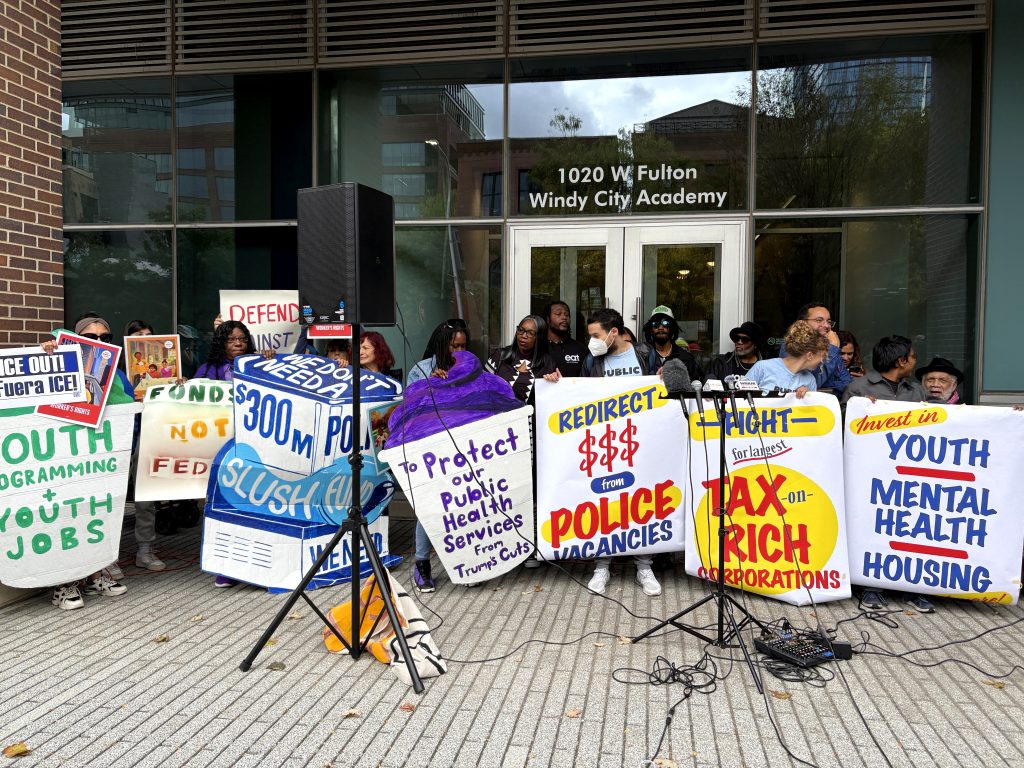
Anthony J. Perkins, a leader with the housing justice team for the community organizing group One Northside, has experienced homelessness. While speaking at the October rally, he spoke about experiencing rent increases and how Trump’s “One Big Beautiful Bill” cuts services to housing programs.
“I know so many folks are experiencing what I went through, and that’s why we need to bring back the head tax, tax big tech, and stand up to billionaires so we can invest in affordable housing. Let’s stand up to Trump and his billionaire friends,” Perkins said. “housing is a human right.”
The One Big Beautiful Bill has been criticized for its benefits to private investors over tenants. The bill cuts $900 million from Medicaid over the next 10 years and, according to an analysis of the bill by the Illinois Environmental Council, the law adds $3.4 trillion to the federal deficit while expanding corporate write-offs “at the expense of hard-working everyday Americans.”
Garcia told The TRiiBE that PUP has been meeting with Chicago City Council members and the next step would be hearing their recommendations in the mayor’s budget address. Ald. Anthony Joel Quezada (35th Ward), Ald. Byron Sigcho Lopez (25th Ward) and Ald. Rossana Rodriguez Sanchez (33rd Ward) were all present during the Oct. 11 action to support PUP’s budget recommendations.
Garcia didn’t say which alderpeople have been opposed to the plan, but said, “If they’re not in support of it, then that means that they’re with Trump and they’re not with us.” She added, “I can tell you right now that I imagine [Ald.] Ray Lopez is right there rooting for Trump right now.”
Through their budget recommendations, PUP focuses on the need for Illinois- and Chicago-based billionaires to be held accountable for working with and profiting off the Trump administration. During the “Funds Not Feds” rally this month, organizers called out Gov. JB Pritzker, demanding he tell his “billionaire buddies” to pay their fair share during the state legislative session, which starts in January.
“It means restoring Medicaid for undocumented people, for poor people, for working people. It means funding transit so they’re not cutting services. It means funding K-12, and we’re going to do a corporate head tax at the city level,” Jackson Potter, vice president of the Chicago Teachers Union, said during the rally. “[Pritzker’s] saying the right things about ICE, now he’s got to say the right things about his billionaire bros, himself included.”
Simpson added that though it’s a “nice slogan” of taxing billionaires, PUP’s four budget proposals don’t include individual taxes on the rich.
“If you look at the four proposals in the platform, it’s not like individual billionaires are going to be paying a huge amount more. That may be a nice slogan, but in fact, many of the taxes don’t target individual people [and] there aren’t that many billionaires in Chicago,” Simpson said.
According to Forbes’ most recent list of the richest people in America, there are 16 billionaires who call Illinois home.
Nathan Ryan, an organizer with PUP, said there’s more to be done, but their budget recommendations are what Chicago can implement now due to restrictions by the state and the recommendations do target the wealthiest folks in the city.
Mayor Brandon Johnson joined a town hall meeting at the Firehouse Community Arts Center, hosted by PUP, on Aug. 21. During the meeting, Johnson said he was committed to passing a budget that supports progressive revenue options. Notably, Johnson pushed for a property tax hike for the 2025 budget cycle, which was voted down by City Council.
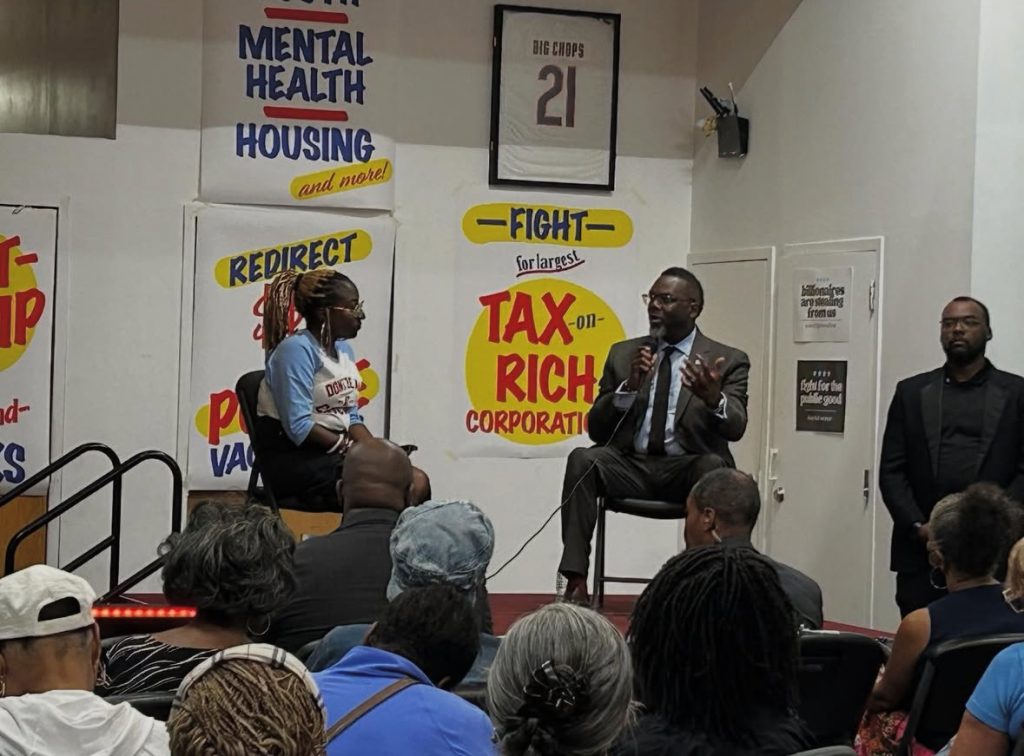
“I’m going to present my budget, and I’m going to do it with the people’s agenda not just in mind, but with the people’s agenda attached to this budget,” Johnson said during the town hall.
Johnson is proposing taking out funds from TIFs to put toward Chicago Public Schools (CPS), according to the Chicago Sun Times. The Sun-Times reported that the move would provide CPS with the $369 million needed for its budget and the $8 million in federal government cuts.
When asked how he expects to successfully implement a progressive budget during a budget briefing on Aug. 29, Johnson said that many elements were at play that involved looking at recommendations from “various entities and groups,” taking it “to the community” and relying on City Council to pass a budget that reflects “the values of what the people of Chicago desire.”
 Español de México
  English